

-
1. What is recommended when driving on dusty gravel roads where vision is reduced?
Show answer
Answer: b) Use low beam headlights.
During dry periods, dust can reduce vision. Use low beam headlights to make your vehicle more visible, slow down, and increase following distance.
-
2. If you are confronted by an aggressive driver, what is the best approach regarding eye contact?
Show answer
Answer: d) Avoid eye contact as it may further anger the driver
When dealing with aggressive drivers, you should avoid eye contact, as looking at them can sometimes escalate their anger. It is safer to ignore gestures and get out of their way.
-
3. How do alcohol and other impairing drugs affect a driver's perception of colors?
Show answer
Answer: a) They reduce the ability to distinguish colors on signs and signals.
Alcohol and drugs reduce your ability to distinguish colors, which is dangerous because much roadway information comes from the colors of signs and signals.
-
4. How do safety belts assist a driver during a sudden turn or impact?
Show answer
Answer: c) They help keep the driver behind the wheel to maintain control.
Safety belts keep you positioned behind the wheel, allowing you to maintain control of the vehicle if you are struck from the side or make a quick turn.
-
5. What should you do immediately if your drive wheels begin to spin while you are accelerating?
Show answer
Answer: d) Take your foot off the accelerator.
If your wheels start to spin, particularly on slippery surfaces, you should take your foot off the accelerator to allow the wheels to regain traction and prevent the vehicle from sliding.
-
6. When exiting a roundabout, what signal should you use?
Show answer
Answer: a) Right signal.
Signal “right” to take the exit.
-
7. How far must you park from a fire hydrant?
Show answer
Answer: b) 15 ft.
Do not park: Within 15 ft. of a fire hydrant.
-
8.
 What should you do if you are driving in a reversible lane and see a steady yellow X signal?
Show answer
Answer: b) Move out of the lane as soon as it is safe to do so.
A steady yellow 'X' indicates that the lane use is about to change. You must prepare to safely vacate the lane.
-
9. What must you do if the light turns green while you are stopped at an intersection?
Show answer
Answer: a) Allow crossing traffic to clear the intersection before you go ahead.
If you are stopped at the intersection and the light turns green, you must allow crossing traffic to clear the intersection before you go ahead.
-
10.
 What does a yellow arrow indicate?
Show answer
Answer: c) The green arrow is ending; prepare to stop and yield.
YELLOW Arrow – This means that the green arrow is ending; you should prepare to stop and yield the right-of-way to oncoming traffic or pedestrians.
-
11.

 How should you treat a flashing red traffic light?
Show answer
Answer: d) As a stop sign.
Flashing RED Traffic Light – This means you must stop behind a stop line, crosswalk, or intersection before entering and use the same procedure as you would at a stop sign.
-
12.
 What does this sign warn of?
Show answer
Answer: d) Sharp Right Turn.
This is a Sharp Right Turn warning sign.
-
13.
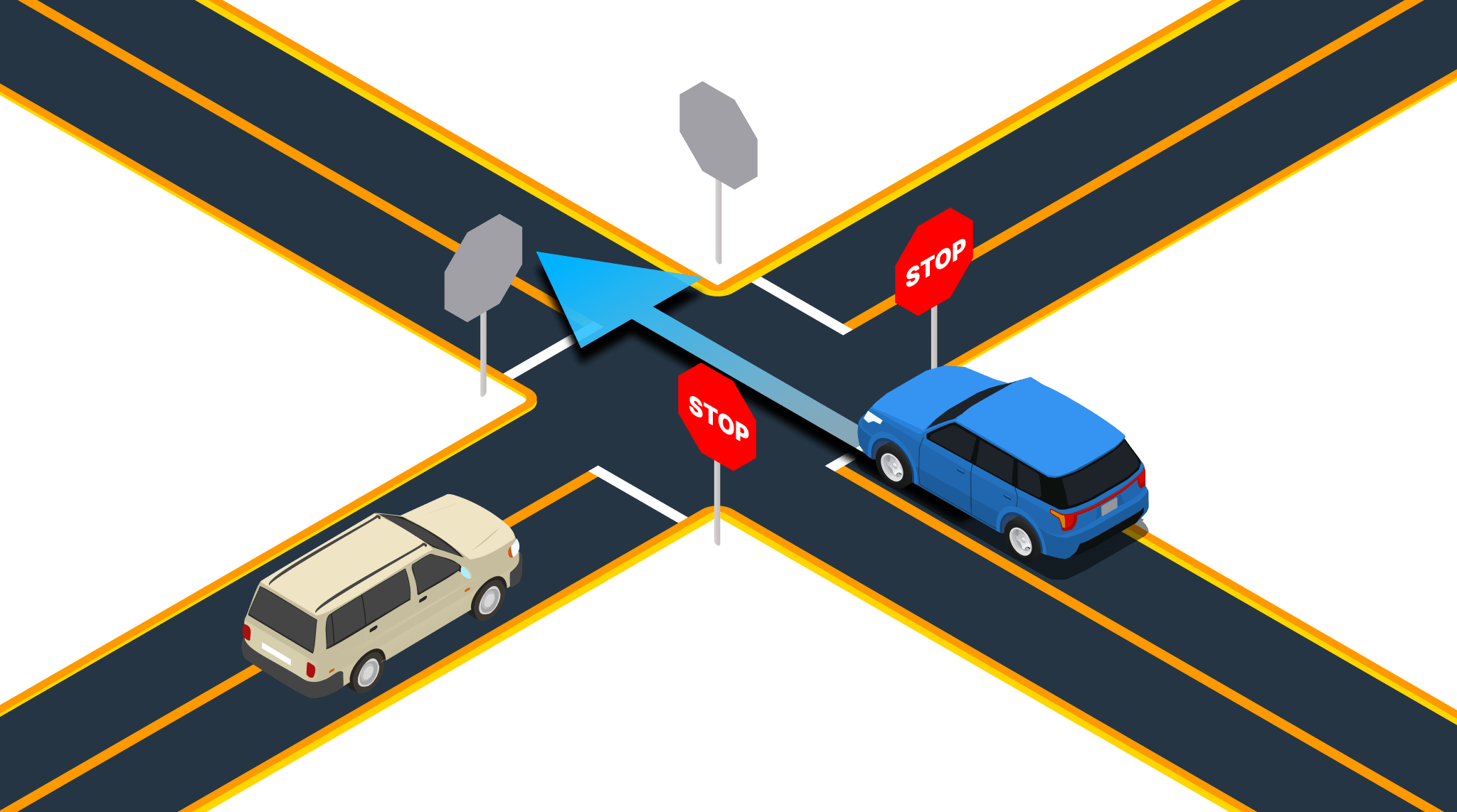 Who has the right-of-way at a 4-way stop?
Show answer
Answer: b) The driver reaching the intersection first.
At a 4-way stop, the driver reaching the intersection first should be given the right-of-way by other drivers approaching the 4-way stop.
-
14.
 What does a dashed white line indicate?
Show answer
Answer: d) You may cross it to change lanes if safe.
A dashed white line between lanes of traffic means that you may cross it to change lanes if a safe gap in traffic is available.
-
15.
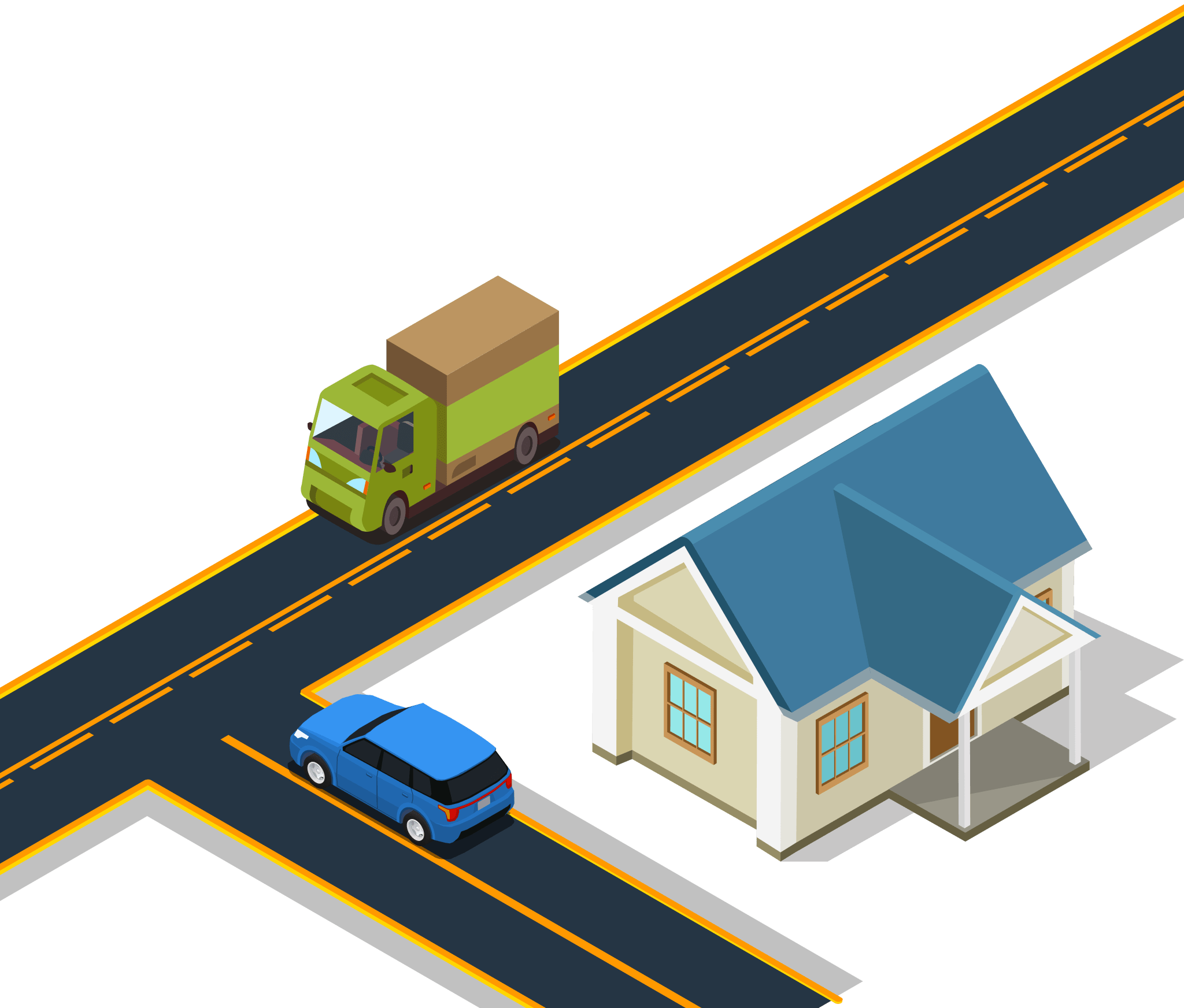
 What must you do when entering a road from a driveway or alley?
Show answer
Answer: c) Yield to vehicles already on the main road.
When entering a road from a driveway, alley or roadside you must yield to vehicles already on the main road.
-
16. You should not start to pass if you are within what distance of a hill or curve?
Show answer
Answer: a) 1/3 of a mile.
Therefore, you should treat a curve or a hill as an oncoming vehicle and should not start to pass when within 1/3 of a mile of a hill or curve ahead.
-
17. How long does it typically take to stop a vehicle traveling at 30 mph, including reaction time?
Show answer
Answer: d) 2 to 3 seconds.
At 30 mph, it can take about 2 to 3 seconds or 123 feet to react to a problem and bring the vehicle to a stop.
-
18. If your accelerator pedal gets stuck, what is the best immediate action?
Show answer
Answer: b) Shift to neutral.
If the accelerator fails, shift to neutral and search for an escape path while steering smoothly.
-
19. How can you recognize that your vehicle has lost traction in the rear tires?
Show answer
Answer: b) The vehicle begins to move sideways without any additional steering input.
Traction loss is recognized by the movement of the vehicle. If the car moves sideways without steering input, the rear tires have lost traction. If the car continues straight while you are trying to steer, the front tires have lost traction.
-
20. When steering to recover from a rear-wheel skid, why is it important to avoid looking into the oncoming lane?
Show answer
Answer: b) To prevent your vehicle from traveling across the centerline.
When recovering from a skid, you should look in the direction you want the vehicle to go. You must avoid looking into the oncoming lane to ensure you do not accidentally steer the vehicle across the centerline.
-
21. If there is no sidewalk available, where should you walk?
Show answer
Answer: b) On the left side, facing oncoming traffic.
If there is no sidewalk, you should walk on the left side of the street facing the oncoming traffic.
-
22. What allows a bicyclist to cross an intersection if the traffic signal does not respond to their bicycle?
Show answer
Answer: c) The Dead Red Law.
Under the Dead Red Law, if you reach an intersection and the traffic signal will not respond to your bicycle, after waiting what you determine is a reasonable amount of time, you may cross the intersection.
-
23. Why might a motorcyclist make sudden changes in lane or speed?
Show answer
Answer: b) To avoid road hazards like potholes or gravel that don't affect cars as much.
Obstacles and road conditions that may be minor to a motorist can be deadly to a motorcyclist... Be prepared for them to make sudden changes in lanes or speed as they attempt to avoid a hazard.
-
24. Are pedestrians required to obey traffic laws?
Show answer
Answer: a) Yes, they have the same responsibilities to obey traffic laws as motorists.
You are subject to pedestrian traffic laws and have the same responsibilities to obey traffic laws as do motorists.
-
25. Does the Move-Over Law apply to towing and recovery vehicles with flashing lights?
Show answer
Answer: a) Yes, it includes towing and recovery vehicles.
State law requires drivers approaching a stationary emergency vehicle displaying flashing lights, including towing and recovery vehicles... to vacate the lane closest.
Keep practicing in the app
Practice Test 1 is one of 10. The app has 225 more Kansas questions, an exam simulator, and review of the questions you miss.


Free download · ★ 4.9 from 65 App Store ratings
Pass Guarantee Don't pass? Your next month is free.